
Forests and the Global Carbon Cycle
Learn about the global carbon budget, including how land sinks and fossil fuel emissions affect carbon dioxide levels, forested carbon pools in the United States, and how carbon cycles naturally through the land and atmosphere.
Forest Carbon Uptake and Storage
Find out more about forested carbon pools, such as the size of different pools, duration of time carbon is within a specific pool, and the transfer of carbon between pools.
Forest management activities can influence the carbon cycle by altering carbon storage and uptake. Forest management is often described as planned human intervention within a forest ecosystem using different practices, tools, and techniques to meet certain management goals. The effects of a specific management practice on forest carbon will vary by site, but core principles of carbon cycling can be applied to better understand, predict, and communicate how management influences forest carbon.
Keeping Forests as Forests
Active forest management does not have the same effect on carbon storage and losses as land use change. A land use change, such as converting forest to non-forest use, generally leads to a long-term decrease in carbon uptake and storage due to the loss of forests, which store more carbon than most other land uses. In contrast, active management, including timber harvests, that aim to maintain forest cover and avoid conversion to other land use types can enable carbon uptake and storage on that land into the future. Although recovery to higher carbon uptake rates after harvests does take time, active forest management practices maintain the essential role of land in the forest carbon cycle.
Tree Biomass and Carbon
In most forests, changes in ecosystem carbon stock are primarily driven by changes in tree biomass. Reducing tree biomass, for example with a management practice such as a timber harvest, reduces forest carbon storage in the short term, but in the decades after the harvest, the regrowth of the forest may increase carbon uptake rates and storage as compared to pre-harvest levels.
If changes in carbon storage are observed at a fine spatial scale and within a short timeframe, a harvest may remove a large portion of the carbon from the stand (Figure 1). However, when observing how a timber harvest on one forest parcel affects total carbon storage across a larger spatial scale and over a longer time period, the reduction in carbon stocks from harvesting a small area may be minimal compared to the total carbon stored across the larger landscape.
Carbon that is removed from the forest as tree biomass during harvest is not immediately emitted to the atmosphere. It can be transferred to other carbon pools, such as dead wood carbon, or to a variety of harvested wood products (HWP). Carbon stored in durable, long-lasting HWP provides more long-term carbon benefits compared to shorter-lived HWP (Figure 2). For example, much of the harvested timber in the Northeastern United States is turned into pulp, which has a short lifespan and relatively quickly contributes to carbon emissions back to the atmosphere. In contrast, more of the harvested timber in the Western United States is converted into long-lasting HWP, such as heirloom-quality hardwood furniture, which continue to store carbon for decades to centuries.
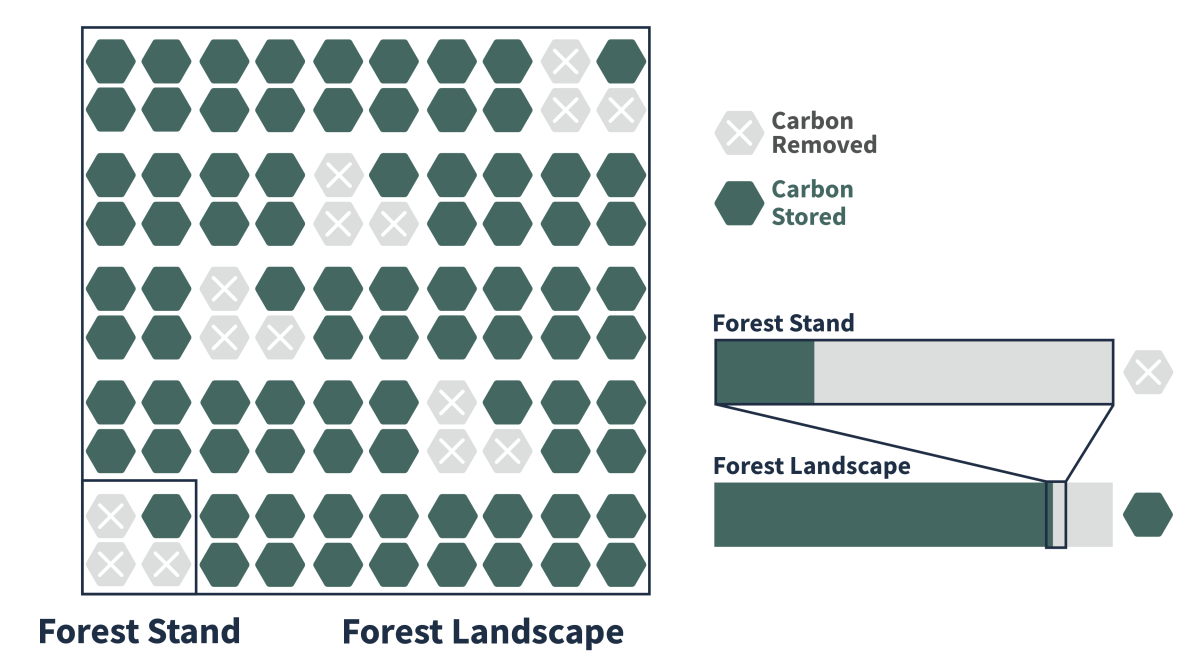
Figure 1.
Estimates of carbon storage vary depending on whether the scale of analysis is at the forest stand level or the forest landscape scale. In this example, management practices, such as harvest within a stand, result in more carbon being removed than stored at the forest stand level. At the larger forest landscape scale, carbon removed is a smaller proportion compared to the total carbon stored, even with additional management practices across the landscape.
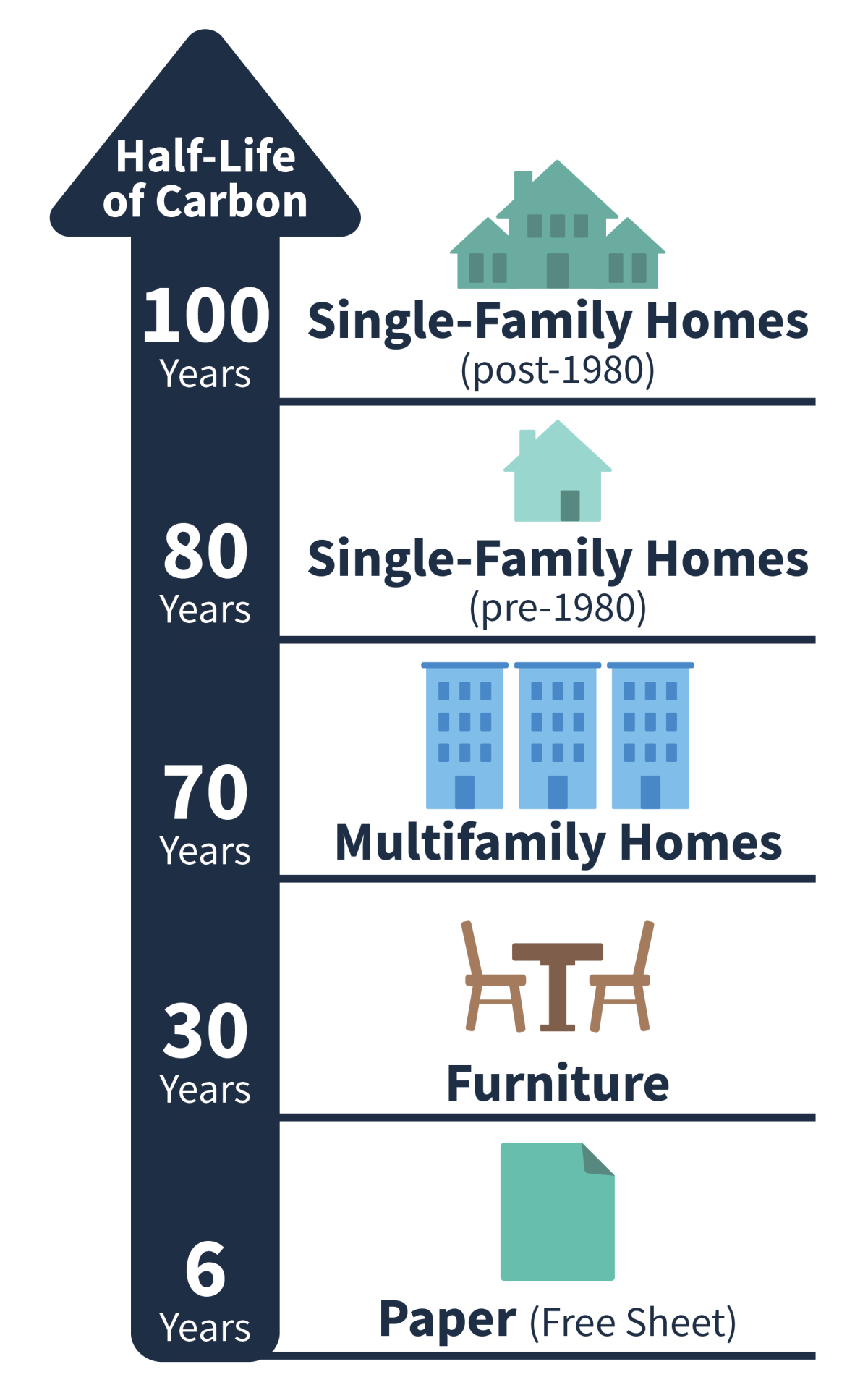
Figure 2.
This graphic compared the estimated amount of time until half of the carbon stored in each harvested wood product is released back to the atmosphere. Adapted from Janowiak et al. (2017).
Minimizing Forest Carbon Losses
Forest management operations, such as harvesting and operating heavy machinery, can release carbon emissions into the atmosphere. However, reducing harvest intensity, lengthening harvest rotations, and increasing stocking or retention levels will generally minimize the amount of carbon lost from management activities, except in cases of severe disturbance. Maintaining high levels of forest structure, for example by leaving residual trees, can also lessen carbon losses after harvest (Nunery and Keeton 2010).
Minimizing soil disturbance during forest management activities can also help to lessen carbon losses. In general, soil carbon losses from harvest activities are small and transitory (Nave et al. 2010), but efforts to protect the soil and limit soil disturbance and erosion can help reduce carbon losses from management.
Active Management for Carbon Benefits
Active forest management can result in short-term losses in carbon storage, but it may also promote carbon benefits over long timescales by reducing the risks of tree mortality, lost vegetative productivity, and major disturbance. Due to human activity, rates of climate change and disturbance are high, increasing, and interacting in new ways. Forest management that is climate adaptive can help address these risks and reduce carbon losses in the future.
Interested in integrating carbon into climate change adaptation planning?
Learn more about forest carbon management and adaptation strategies and approaches
Key Terms
- Biomass
- Carbon cycle
- Carbon emissions
- Carbon pool
- Carbon storage
- Carbon uptake
- Disturbance
- Ecosystem
- Forest management
- Forest stand
- Harvested wood products
- Land use change
For more terms and definitions, see the Carbon Terminology page.
About this Topic Page
This text was prepared by:
- Adrienne Keller, Northern Institute of Applied Climate Science, Michigan Technological University.
- Katie Frerker, Northern Institute of Applied Climate Science, USDA Forest Service Eastern Region.
- Manashree Padiyath, formerly Northern Institute of Applied Climate Science, USDA Forest Service Northern Research Station.
- Kailey Marcinkowski, Northern Institute of Applied Climate Science, Michigan Technological University.
Graphics were adapted, designed, and produced by Kailey Marcinkowski, Northern Institute of Applied Climate Science, Michigan Technological University.
This topic page is part of a collection of resources related to understanding forest carbon.
References
Janowiak, M.; Connelly, W.J.; Dante-Wood, K. [et al.]. 2017. Considering forest and grassland carbon in land management. Gen. Tech. Rep. WO-95. Washington, DC: U.S. Department of Agriculture, Forest Service. 68 p. https://doi.org/10.2737/WO-GTR-95.
Nave, L.E.; Vance, E.D.; Swanston, C.W.; Curtis, P.S. 2010. Harvest impacts on soil carbon storage in temperate forests. Forest Ecology and Management. 259: 857–866. https://doi.org/10.1016/j.foreco.2009.12.009.
Nunery, J.S.; Keeton, W.S. 2010. Forest carbon storage in the northeastern United States: net effects of harvesting frequency, post-harvest retention, and wood products. Forest Ecology and Management. 259: 1363–1375. https://doi.org/10.1016/j.foreco.2009.12.029.