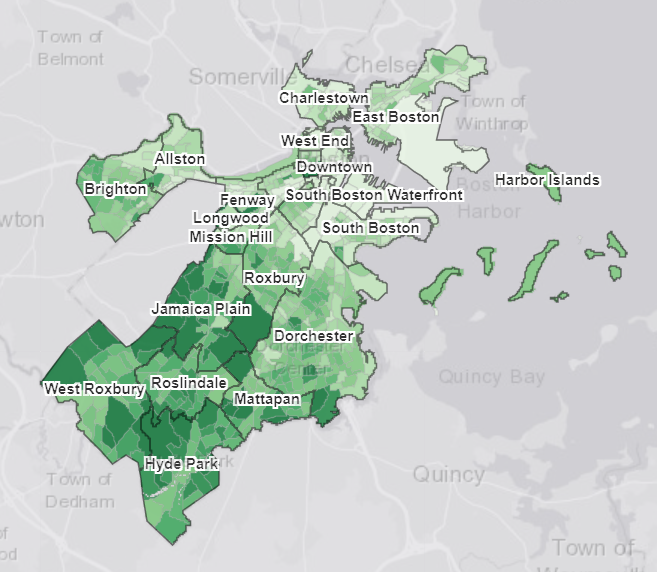
The Northern Institute of Applied Climate Science and American Forests are offering an Urban Forest Climate Adaptation Workshop Series tailored to the greater Boston Region. Participants will be empowered to integrate climate adaptation into real-world urban forest planning and activities. They will consider how the ongoing and projected climate changes for the region are likely to impact the urban forest, learn about the adaptability & vulnerability of the region’s tree species to climate change, and apply a climate adaptation planning process to their own real-world project.
This unique opportunity provides direct training in considering climate change information and identifying adaptation actions using NIACS' Quick Guide to Adaptation Planning. We will also use the new Boston Region: Tree Species Vulnerability Assessment and other urban forestry adaptation resources co-developed by NIACS and American Forests. Participants will receive coaching and feedback on their own real-world climate adaptation project!
Continuing education credits: The full series has been approved for 4.5 CEUS by the ISA New England Chapter, and 3 CEUS by the Massachusetts Arborists Association.
Audience
This training is designed for those working in or adjacent to urban and community forestry in the greater Boston Region. This may include, but is not limited to: urban forestry professionals, city staff, planners and landscape architects, private consultants, extension employees, environmental and conservation non-profits, and community members. Individuals as well as small teams can participate in the course, and we encourage group participation!
Course Learning Objectives
● Understand how climate adaptation and mitigation fit into the goals and responsibilities associated with stewardship of the urban forest.
● Identify locally important climate change impacts, challenges, and opportunities.
● Use the new ‘Boston Region: Tree Species Vulnerability Assessment’ and related resources to integrate climate adaptation into real-world urban forest planning and activities.
● Communicate with stakeholders about climate impacts and adaptation responses.
We ask participants to bring their own real-world projects. Example projects could include:
• a neighborhood urban forest master plan
• a restoration project in a local park
• an urban development project that incorporates natural landscape features
• tree planting outreach materials tailored to the community
Virtual Workshop Schedule
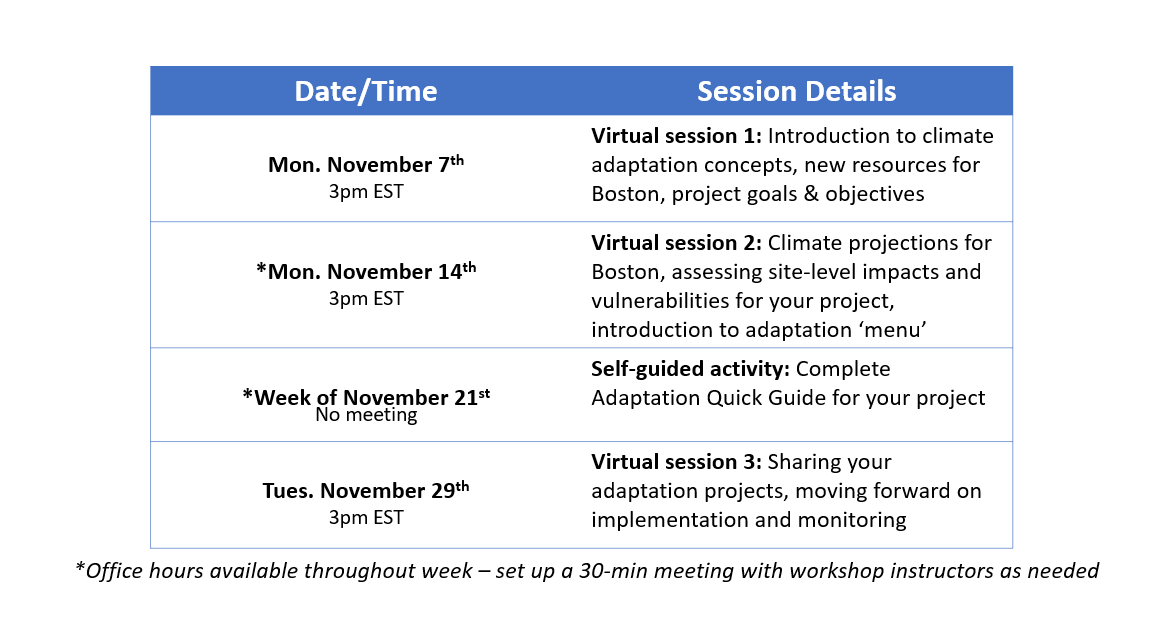
This course will be held over four weeks requiring three 90-minute virtual live classes hosted on Zoom, with a 'break week' in the middle when participants are encouraged to complete an assignment related to their real-world project. Instructors will provide guidance and have office-hours available for checking in throughout the workshop series. Please note that while the first two meetings are on Mondays, the final meeting is on Tuesday, November 29th in order to accommodate for potential travel conflicts due to the holiday weekend.
Many of the resources that will be introduced and utilized in this workshop series were developed by NIACS in collaboration with American Forests. Molly Henry, Director of Climate & Health with American Forests, will also be joining to assist with facilitation of the workshop series.